
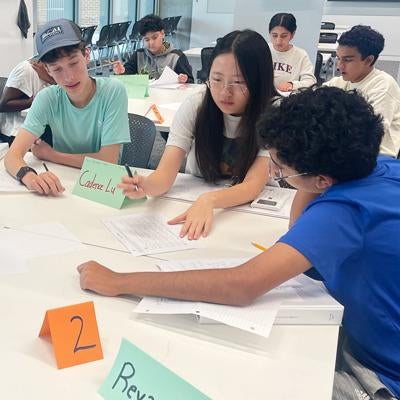
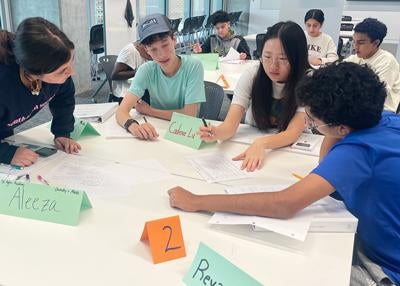
For two weeks this summer, a wave of curious high school students prepared themselves to tackle the new school year by attending the Rice University School Mathematics Project Preparing for Success programs.
Designed for middle- and high-school students who will take algebra I, geometry, algebra II and precalculus courses in the fall semester, these programs offer an opportunity to strengthen foundational skills and build mathematical intuition in a supportive environment.
For students like Eliana Murillo Rojas, a rising sophomore at DeBakey High School for Health Professions, these programs served to ease the transition into a new school year. Last year, Murillo Rojas attended Preparing for Success in Algebra I. This summer, she returned to take both Preparing for Success in Geometry and Preparing for Success in Algebra II in preparation for a packed schedule in the fall.
“It helped me a lot to get ahead of my classmates,” said Murillo Rojas. “That’s why I came back.”
For many students, the Preparing for Success programs serve as a bridge between math classes. The curriculum is structured to review and strengthen the fundamentals from previous years and begin building the foundational skills to move forward. But these programs are more than about staying ahead. For many students, RUSMP’s programs provide their first opportunity to experience math as something deeper than formulas and test scores.
One of the greatest strengths of RUSMP is the leadership provided by its award-winning master teachers: Pei How Chin, math teacher at Bellaire High School; Leland Dix, math teacher at Annunciation Orthodox School; Gail Hamilton, St. Thomas More math teacher; and Joanna Papakonstantinou, math teacher at Episcopal High School. These teachers bring deep experience and educational insight to the classroom. Master teachers and teaching assistants are selected for their passion and experience. Their presence ensures that students receive both rigorous instruction and helpful encouragement: the perfect environment for them to prosper. As a result, students are able to see mathematics from the perspective of someone who truly understands and engages deeply in the field.
Rigor comes from thinking more about a problem, not just doing more problems.
— LELAND DIX
That spark was evident to parent Max Wintermark, whose son Grant participated in Preparing for Success in Precalculus. “This deeper understanding has transformed how Grant views math and science,” he said. “I am confident it will shape his academic journey for years to come.”
Alejandra Sanchez-Vence, a rising eighth grader at Cornerstone Academy and participant in Preparing for Algebra I, described the experience as both enjoyable and impactful. “It’s been fun and a great learning experience. It’s really helped me a lot for the upcoming year.” She praised the interactive, partner-based learning model that made math both fun and accessible.
This spirit of collaboration and hands-on learning is exactly what the programs aim to cultivate, and for longtime instructor and Rice alum, Joanna Papakonstantinou ’92 it’s at the heart of the program. With several degrees (four from Rice) and over a decade of teaching experience under her belt, she says that she is still consistently impressed with the difference the programs make in students from all backgrounds. “They gain self-confidence and are eager to begin the new academic year with a strong foundation.”
This year’s session also saw the addition of a new course: Solving Problems that You Probably Will Never See in School. Designed for middle-school students, the program focused on strengthening the fundamental skills required for mathematical reasoning rather than specific topics that may be covered in a traditional classroom setting. This program was led by Leland Dix, an eighth-grade math teacher at Annunciation Orthodox School.
“By the end of the program, students were much more comfortable explaining their process to their peers and getting ideas from one another,” Dix said. “Rigor comes from thinking more about a problem, not just doing more problems.”
By removing the expectation often placed on students in a fastpaced classroom environment, Dix says that students “really reveled in the luxury of having more than two hours together to tinker, make mistakes and uncover new discoveries.”
With its supportive environment, passionate educators and innovative curriculum, RUSMP continues to reshape how students experience and understand mathematics — equipping them with tools not just for the classroom, but for life.
RACHEL PARR '27
Undergraduate Student
Rice University
BRANDON WU
Student, Upper School
St. John's School