
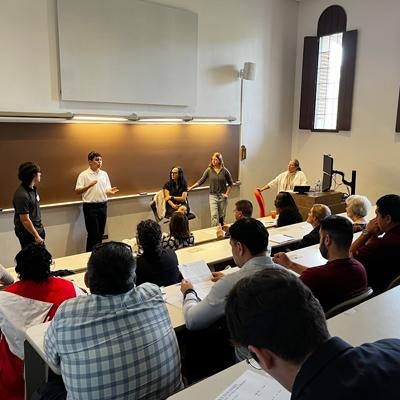
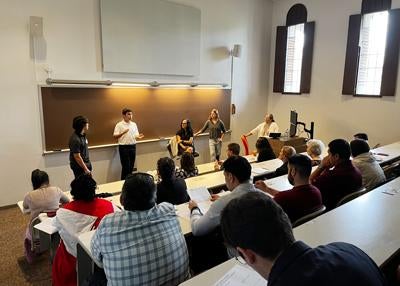
The 79th Rice University School Mathematics Project Networking Conference focused on one of the most important questions in education: “How do students learn how to learn?”
The conference, which took place last fall at Rice, featured two engaging panels: one composed of students and the other of award-winning mathematics educators. Each group shared insights, experiences and practical strategies for helping students become self-directed, lifelong learners.
Three students from RUSMP’s Preparing for Success in Precalculus and Calculus summer programs, Michael Antonio, from Blanson CTE Senior High School; Viana Elliyoun, from DeBakey High School for Health Professions; and Grant Wintermark, from Strake Jesuit College Preparatory spoke candidly about what helps them learn. Their reflections were grounded in real classroom experience and revealed several consistent themes.
They agreed that learning often begins with failure and that making mistakes is an essential part of the learning process. They described how struggling through challenges creates the most authentic learning and how collaboration through group work and class discussions enhances comprehension. They emphasized that students should not be afraid to be wrong, because growth depends on taking risks and asking questions.
Organization and time management also emerged as key components of success. The students mentioned that tools such as highlighters and flashcards help them organize information and study more efficiently. Most importantly, they stressed that understanding concepts deeply is far more effective than simple memorization. As one student put it, “Memorizing might be easier, but explaining what you’re learning to someone else helps you really understand it yourself.”
The students also shared their appreciation for teachers who create classrooms where questions are welcomed and mistakes are viewed as part of the process. They said that feeling safe and supported allows them to take intellectual risks and engage more fully in the learning process.
The educators’ panel brought together three respected math teachers: Cheryl Latiolais, from the University of Houston Central Campus; Betul Orcan-Ekmekci, from Rice University; and Joanna Papakonstantinou ’92, from Episcopal High School. They spoke passionately about how teachers can help students learn more effectively. Each emphasized that teaching should focus on the student as an individual rather than treating a class as a uniform group.
Memorizing might be easier, but explaining what you’re learning to someone else helps you really understand it yourself.
They urged teachers to aim for mastery of content by the end of the school year rather than rushing through material for the sake of coverage. The panelists agreed that students must truly understand the mathematics they are learning, rather than merely memorizing steps to complete problems. They also emphasized the importance of precise mathematical STUDENTS LEARN HOW TO LEARN language, particularly for English Language Learners, and the value of allocating time for students to reason, explain their thinking and engage in mathematical conversations.
The educators cautioned against the growing trend of accelerating students too quickly through the curriculum. They warned that this practice often leads to knowledge gaps and frustration in the long run. Instead, they called for classrooms that develop confidence, patience and a genuine love of mathematics. “Students are not test scores,” one educator reminded the audience. “Grades should reflect what a student truly knows, not how quickly they finished the course.”
Following the panels, attendees joined breakout discussions to explore questions such as: What is the relationship between teaching and learning? Who truly controls learning — the teacher or the student? What barriers prevent learning at home, school and in broader education systems? Does effective teaching always lead to learning, and if not, where does responsibility lie? Paige Naughton, a former student of Papakonstantinou’s at Episcopal High School and a Rice undergraduate in chemical engineering, joined one of the breakout sessions to share her advice on learning.
These conversations allowed attendees to exchange ideas, extend the dialogue, and identify practical ways to support deeper learning in classrooms and communities. By bringing together student voices, experienced educators and engaged community members, the networking conference reaffirmed an essential truth: learning how to learn is not just a classroom skill — it is the foundation for a lifetime of growth, curiosity and success.
ANNE PAPAKONSTANTINOU
Director
Rice University School Mathematics Project