
Rice’s Master of Social Policy Evaluation offers a program that explores specific social policies, such as criminal and juvenile justice, public health, early childhood development and education, and labor markets.
Last summer, MSPE students had an opportunity to engage in hands-on learning with a community organization. Building on the longstanding partnership between United Way of Greater Houston and the Kinder Institute for Urban Research, students completed a capstone project in which they analyzed and evaluated data for a local nonprofit organization.
“This really is a time to practice and to experience what a partnership with a community organization is like,” said Jessica Davison, assistant vice president of mission and strategy for United Way of Greater Houston.
A primary aim of the United Way of Greater Houston is to support nonprofits with their data and evaluation capacities through an effort called Coffee and Quality.
“We want nonprofits to be able to collect data and to use that data to improve the work that they’re doing, whatever that might look like based on their mission,” said Davison. “We really meet organizations where they are.”
Coffee and Quality includes case studies, which feature nonprofit organizations that would like to enhance their quality data practices. The Kinder Institute provides the expertise needed to review, analyze and interpret the data for the case study organizations, addressing their questions, what they hope to better understand about their work and how they can improve their data practices. Not only does the partnership benefit the case study organization, but the information is then shared with the larger local nonprofit sector to impart lessons learned and to expand understanding of best practices.
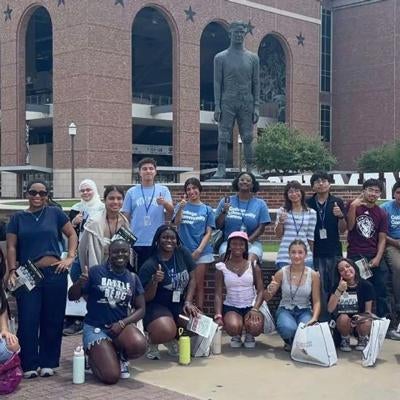
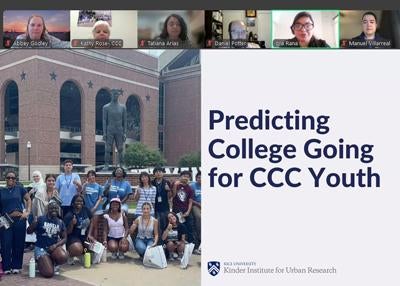
The summer 2025 MSPE capstone constituted a case study of College Community Career, a nonprofit organization that helps young adults, especially low-income, first-generation students get into college. The students collaborated with the organization over a four-month period, evaluating their data, engaging in conversations, answering questions and completing monthly check-ins. In August, MSPE students presented their case study, Predicting College Going for CCC Youth, providing key insights for CCC and the Houston community. With the capstone’s success, the MSPE program is continuing and expanding this type of community- engaged research.
We want nonprofits to be able to collect data and to use that data to improve the work that they’re doing, whatever that might look like based on their mission. We really meet organizations where they are.
— JESSICA DAVISON
“The United Way of Greater Houston is a valued partner of the Kinder Institute,” said Daniel Potter, director of the Houston Population Research Center at the Kinder Institute and MSPE faculty member.
“Expanding this partnership to Rice’s MSPE program enabled students to engage in applied data and evaluation work outside the classroom. At the same time, the case study capstone experience also provided support for a local community organization that is impacting the lives of many, with its meaningful, mission-driven work.”
With the success of the recent capstone, the MSPE program is continuing and expanding this type of community-engaged research.
KIM PHILIPPI
Assistant Director of Marketing and Communications
Rice University School of Social Sciences