

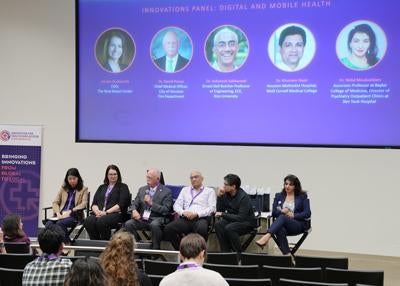
The inaugural Innovation for Healthcare Access Conference was held at Rice University’s Bioscience Research Collaborative in October to address ways to improve health care access. The cross disciplinary conference explored ideas for advancing quality maternal, newborn, and chronic disease care in rural and underserved communities.
Hosted by Rice360 Institute for Global Health Technologies, the conference is part of Rice360’s mission to support improvements in health care throughout Texas and beyond through collaborative efforts to provide life-saving technologies and quality care in every community. It brought together more than 320 attendees, including engineers, clinicians, innovators and community health leaders from Texas and beyond. Four keynote speakers and 26 expert panelists shared their inspiring experiences and recommendations on closing the gaps in health care access.
In her keynote speech, Dr. Kristie Wilburn-Wren addressed the issue of making care safer for Texas mothers through extending the Maternal Care After Pregnancy program. She explained that 46.5% of Texas is a “maternal care desert,” lacking obstetric and gynecological doctors, with rural women facing a 50% higher risk of maternal death. And critically, most maternal deaths occur well after delivery, with 71% happening in the year following giving birth. Combined, these underlie the high maternal mortality rates seen in Texas.
Dr. Jacqueline Alvarado from the Texas A&M Rural and Community Health Institute discussed their programs aimed at improving health care access through obstetric emergency simulation training and telehealth prenatal care.
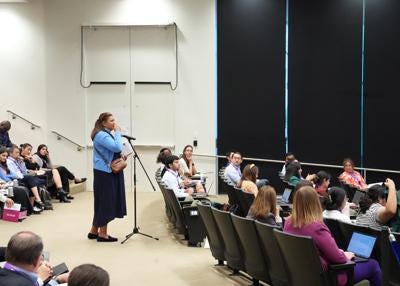
“When a maternal patient arrives at many rural facilities in Texas, they are cared for by health workers who often do not have any experience in delivering a baby and are working with limited supplies.”
Her team visits rural health care settings to provide basic obstetrics training, using available resources to make it practical. Workers get hands-on experience using simulation models in basic and complex deliveries and postpartum care, such as control of maternal hemorrhage or heart complications during delivery. When combined with telehealth, these facilities offer continuity of care and comprehensive support.
Dr. Krishna Udayakumar, director of Duke Global Health Innovation Center at Duke University, closed the first day of the conference with a presentation on health systems innovation to improve maternal and child health. Reflecting on the U.S. as a global outlier, with a pregnancy-related mortality rate that is much worse than any other high-income country, he noted the significant disparity by race and geography.
“We are not a single population when looking at the burden of disease; there are different health stories within the U.S.” With the pipeline of health innovation as strong as it has ever been, he warned that their design and development must be inclusive to effectively reach the people who need new solutions the most.
EBONY THORNTON
Communications Manager and Digital Specialist
Rice 360
CARRIE NOXON
Senior Technical Writer
Rice 360