
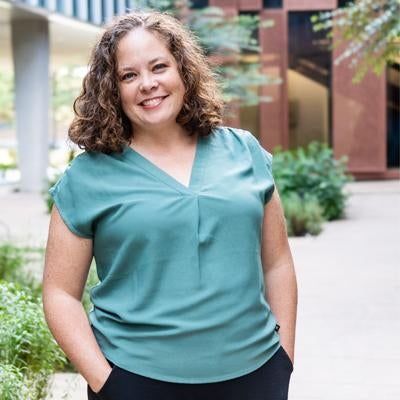
Erin Baumgartner grew up in a working class neighborhood on the South Side of Chicago, where, at an early age, she witnessed the disparities that surrounded her, especially when her elementary school had to be locked down because fights broke out at the high school across the street.
Both of her parents worked full time; her father was a locksmith, and her mother was an accountant at a law firm. “There were times when we were probably living paycheck to paycheck,” Baumgartner said. Despite the financial strains, her parents managed to put her in a Catholic school, from elementary to high school, not for religious reasons, but for safety concerns.
It was those inequalities she experienced at an early age that spurred her to study sociology in college. “There was this curiosity for me of why my parents made that decision and why they felt they had to do that,” she said.
At the University of Notre Dame, she chose to major in sociology and marketing, as she aspired to work as a fundraiser for a nonprofit organization. After receiving her bachelor’s degree in business administration in 2004, she joined the Youth Service Bureau in South Bend, Indiana, where she spent three years raising funds for the nonprofit, which provides safety and shelter to homeless and runaway teenagers.
“I felt like they were really supporting young people and their families, but I wanted to find a way in which I could make a bigger contribution,” she said. She believed that the way was through research. The desire to know why disparities existed still gnawed at her, and she pursued more education: two master’s, one in sociology from the University of Chicago in 2008 and another in education from the University of Illinois at Chicago in 2010; and, finally, a Ph.D. in sociology from Pennsylvania State University in 2015.
Almost immediately after receiving her Ph.D., she came to Rice as a postdoctoral fellow to do research at the Houston Education Research Consortium, part of the Kinder Institute for Urban Research. She ascended rapidly. Every two years, or close to it, she advanced in HERC, progressing from postdoctoral researcher to research scientist to associate director and then to director.
Ruth López Turley, director of the Kinder Institute and founder of HERC, was instrumental in hiring and cultivating Baumgartner’s career at Rice. “Erin is an excellent leader and researcher who cares deeply about ensuring that all students have access to the educational resources and opportunities they need to thrive,” Lopez Turley said.
“Under her leadership, HERC has done outstanding research that has informed many districts’ actions in a variety of areas, especially pre-K. It’s a privilege working with her,” she said.
HERC has partnered with eight school districts — Alief, Aldine, Spring, Spring Branch, Katy, Klein, Pasadena and Houston — to provide them with research-driven data that will guide them in resolving critical issues that affect educational equity.
When selecting research topics, HERC always consults with school districts to determine their interests. “There’s not a study that you’ll find on our website that’s about a topic that we decided to do on a school district,” Baumgartner explained. “We want to make sure that the research we do is in partnership with districts, so that they’re involved in the topic because otherwise they won’t use the information we provide.”
I believed that through research I could help more people. I always wanted to understand why disparities existed.
— ERIN BAUMGARTNER
Among the many research projects HERC has led, three stand out as especially important to her. The first is the work she led in early childhood education and how important it is to later academic success. Research, she said, suggests that early childhood DISPARITY GAP Continued From Page 1 education is a critical part of closing the gap between student groups. “I believed that through research I could help more people,” she said. “I always wanted to understand why disparities existed.”
A second topic is understanding the needs of emergent bilingual students or students who are still developing their English skills. About one-quarter of the Texas student population falls under this category, and although many of these students achieve academic success, many others struggle academically and may even drop out of school or fail to attend college. “So, we’re making sure that there are programs and support in place for those students and their parents.”
A third topic is how well students are prepared for college and careers, as well as other pathways such as technical jobs. HERC examines the benefits of college preparatory courses, dual-credit college coursework, career and technical education programs, internships and career-related training.
As soon as the research is available, HERC provides the information to the school districts so they can make informed decisions, Baumgartner said. “School districts are using the information for planning and important decisions they need to make.”
For example, several school districts started a social media campaign using HERC’s research data to inform families about the importance of early childhood education. Another district completely revamped its multilingual program to help emergent students succeed in school.
Baumgartner said that she has remained at Rice for 10 years because people believe in the importance of the work HERC is doing in the communities. “They see it’s an investment in Houston, and as a result, we’re supported in doing our work.”
She also derives great satisfaction from seeing school districts use HERC’s research to make positive changes and close the disparity gap.
“It gives me goosebumps to think that the work we are doing is connected to real people, and hopefully it’s going to have an impact on the lives of those people long after we complete our research.”
DAVID D. MEDINA
Director, Multicultural Community Relations
Office of Public Affairs